Ruby Ranch Internet Cooperative Association,
Petitioner,
v.
Qwest Corporation,
Respondent.
DOCKET NO. 01B-493T
RUBY RANCH INTERNET COOPERATIVE ASSOCIATION REPLY IN SUPPORT OF ITS PETITION FOR ARBITRATION
The Ruby Ranch Internet Cooperative Association (hereafter, the “Coop”) submits this Reply to the Response that Qwest Corporation (“Qwest”) filed on November 19, 2001 and which the Coop received on November 23, 2001.(1) As demonstrated below, Qwest still has made no attempt to justify its position regarding the three unresolved issues that the Coop raised in its Arbitration Petition.(2) Given Qwest’s utter failure to meet its burden of proof, the Coop submits that arbitration hearings would be pointless and that that the Coop is entitled to summary judgment as a matter of law. At minimum, the Commission should require Qwest to submit prior to any arbitration hearings all facts that it intends to rely upon so that the Coop can be prepared to respond. The Coop should not be placed at a disadvantage because Qwest has refused to provide material facts for nearly six months.
I. QWEST HAS FAILED TO COST JUSTIFY ITS PROPOSED NON-RECURRING FEES
The Coop seeks to lease certain Qwest subloops located entirely on Ruby Ranch so it can provide high-speed Internet access services to its member-subscribers, all residents of Ruby Ranch. Section 252(d)(1) of the Communications Act specifies that prices for unbundled network elements “shall be based on the cost . . . of providing the network element.”
Qwest initially demanded that the Coop pay $21.32 monthly for each subloop that it leases. Qwest later reduced its price to $15.12 monthly and then to $8.33 monthly. While the Coop believes a price of $8.33 is excessive for subloops ranging in length from 0.25 to 1.2 miles, the Coop will not quibble over this amount, and for that reason it did not raise the recurring price in its Arbitration Petition.
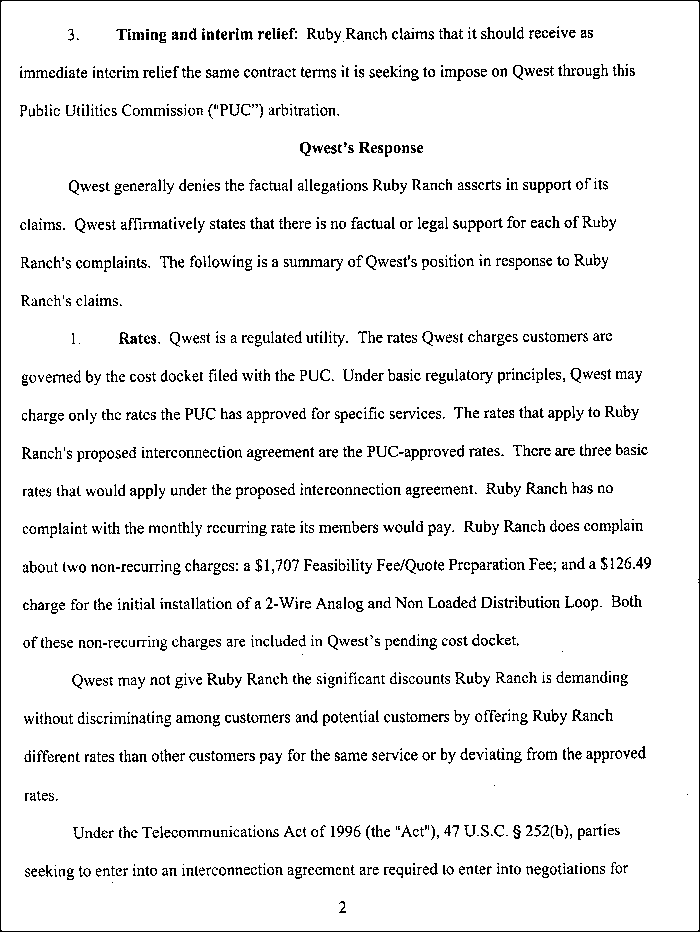
The Coop does challenge the two non-recurring fees that Qwest wants to impose on it: (1) a $1,707 Feasibility Fee/Quote Preparation Fee; and (2) a $126.49 charge for the installation of each subloop.(3) The Coop repeatedly asked Qwest during the parties’ discussions for supporting cost data, but Qwest consistently refused to provide this data, stating that these terms were offered on a “take it or leave it” basis. Qwest again chose not to furnish supporting cost data in its Response.
A. Qwest Has Engaged in Bad Faith by Refusing to Provide Supporting Data for Its Proposed Non-Recurring Fees
The Federal Communications Commission (“FCC”) has held that it is “reasonable for a requesting carrier to seek and obtain cost data relevant to the negotiations.”(4) The FCC has further ruled that “an incumbent LEC may not deny a requesting carrier’s reasonable request for cost data during the negotiation process, because . . . such information is necessary for the requesting carrier to determine whether the rates offered by the incumbent LEC are reasonable.”(5)
The Coop has repeatedly asked Qwest to provide supporting facts for its proposed non-recurring fees, but Qwest has repeatedly refused to furnish this information.(6) Qwest’s failure to provide any supporting cost data constitutes bad faith. FCC rules explicitly provide:
If proven to . . . an appropriate state commission, . . . the following actions or practices, among others, violate the duty to negotiate in good faith: . . . (8) refusing to provide information necessary to reach agreement.(7)
The negotiation process that Congress has established will not work if the incumbent LEC refuses to provide cost data supporting its proposed charges. The Commission should be concerned by Qwest’s refusal to follow one of the most basic rules of interconnection negotiations, and the Coop urges the Commission to impose appropriate sanctions so that Qwest does not engage in this unreasonable conduct in the future.
B. The Coop Seeks Cost-Based Rates, Not Discounted Service
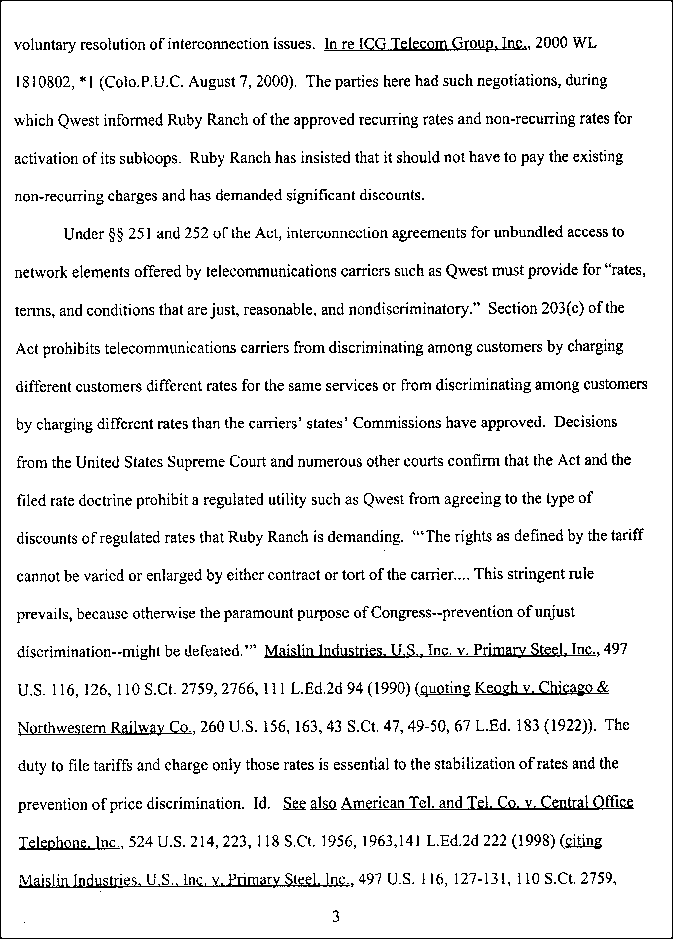
Three times in its brief Response Qwest asserts that the Coop is demanding “significant discounts.”(8) This assertion is not accurate, as the Coop seeks only to pay prices based on Qwest’s actual costs, as Section 252(d)(1) requires. Moreover, Qwest’s “discount” assertion cannot possibly be accurate since Qwest has never supplied to the Coop any documentation demonstrating that its proposed non-recurring fees are cost based. Qwest’s “discount” assertion is nothing less than a weak attempt to divert the Commission’s attention from its own failure to provide supporting cost data.
C. Qwest’s Defense – It Has No Choice But to Charge the Rates in Its SGAT – Lacks All Merit
Qwest asserts that it is relieved of having to cost justify its non-recurring fees because its proposed charges are contained in its Statement of Generally Available Terms (“SGAT”):
Under basic regulatory principles, Qwest may charge only the rates that the PUC has approved for specific services. The rates that apply to Ruby Ranch’s proposed interconnection agreement are the PUC-approved rates.(9)
In other words, Qwest asserts that its SGAT is like a tariff and that as a result, (a) it has no choice but to offer services per the terms and prices specified in the SGAT, and (b) there is no reason to conduct interconnection negotiations because the terms and prices set forth in its SGAT always control. This argument is baseless.
An SGAT is not a tariff, for as the FCC has held, “Section 252 of the 1996 Act . . . provides for interconnection arrangements rather than tariffs.”(10) To be sure, the Communications Act gives Qwest the option of filing an SGAT. However, Congress was very clear that such an SGAT does not relieve Qwest from negotiating an agreement with the Coop that contains terms and prices different from than those contained in an SGAT:
The submission or approval of a statement under this subsection shall not relieve a Bell operating company of its duty to negotiate the terms and conditions of an agreement under section 251 of this title.(11)
Indeed, Qwest’s own SGAT notes that its SGAT is only “an alternative to negotiating an individual interconnection agreement with Qwest”:
In this respect, neither the submission nor approval of this SGAT nor any provision herein shall affect Qwest’s willingness to negotiate an individual agreement with any requesting carrier pursuant to Section 252 of the Telecommunications Act of 1996.(12)
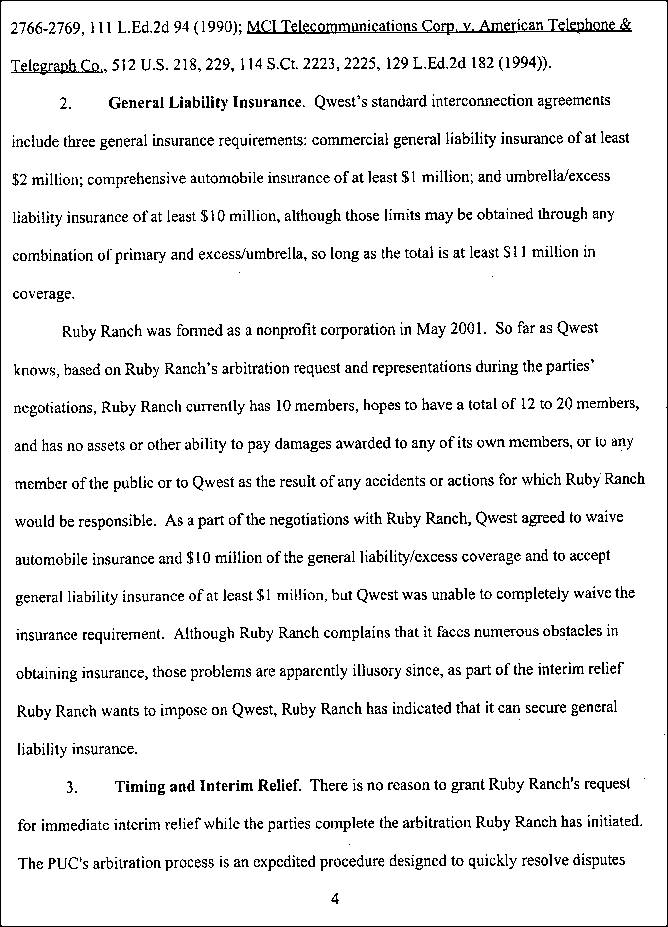
Qwest’s own conduct in this proceeding is, moreover, incompatible with the position that Qwest takes in its Response. Qwest’s SGAT requires that an interconnecting carrier obtain an $11 million insurance policy,(13) and this $11 million insurance requirement would be non-negotiable according to the theory Qwest takes in its Response. Yet, Qwest has lowered its insurance demand to $1 million (the validity of which is discussed below), confirming that even Qwest acknowledges that the terms in its SGAT are negotiable.
Sections 251 and 252 of the Communications Act give the Coop the right to obtain unbundled network elements based on its unique circumstances and based on the costs Qwest incurs in providing the network elements to the Coop. (14) Qwest’s fear of discrimination is unfounded. In fact, it is Qwest’s proposed fees that are discriminatory. For example, a quote preparation fee of $1,707 may be cost justified for a complex interconnection arrangement, but as discussed below, such a fee is not justified for the installation of the simple screw terminal that Qwest wants to install for the Coop’s lease of subloops.
D. The Commission Should Establish a Quote Preparation Fee of $33.17 and an Activation Fee of $35 for the First Subloop and $20 for Additional Subloops
The Communications Act specifies what the Commission is to do where, as here, the incumbent LEC refuses to provide the information that the Commission needs to render a decision:
If any party refuses or fails unreasonably to respond on a timely basis to any reasonable request from the State commission, then the State commission may proceed on the basis of the best information available to it from whatever source derived.(15)
As noted above, Qwest’s refusal to provide any supporting cost data constitutes bad faith and, the Coop submits, this omission would justify an order prohibiting Qwest from imposing any non-recurring fees on the Coop. Nevertheless, the Coop acknowledges that Qwest will incur some costs in inactivating the subloops, and the Commission may decide to impose a different sanction for Qwest’s negotiation in bad faith. (The Coop doubts that a waiver of the non-recurring fees in this instance would be a sufficient penalty to prevent Qwest from engaging in the same conduct in the future.) The Coop below identifies what it believes would be a fair and cost-justified price for the two non-recurring fees at issue based on the “best information available.”
Qwest proposed activation fee of $126.49 for each subloop is clearly not cost justified. If the Coop rented the entire loop to Qwest’s serving end office rather than a subloop located entirely on Ruby Ranch, Qwest would charge the Coop $70 to activate the first loop and $40 to activate additional loops.(17) Because activation of the subloops that the Coop seeks to rent would require Qwest to perform half the work of installing full loops, an activation fee of $35 for the first subloop and $20 for additional subloops – half of its SGAT prices for unbundled loop activation – would appear to be fair, reasonable and cost-justified.
II. AN INSURANCE POLICY IS INAPPROPRIATE BECAUSE THE COOP’S ACTIVITIES IMPOSE NO RISK OF HARM TO QWEST – A FACT QWEST HAS ALREADY CONCEDED
The Coop does not seek to interconnect with the network that Qwest uses in the provision of its own telecommunications services. While the Coop seeks to lease certain copper subloops, those subloops would be entirely separate from the loops Qwest uses for its own services (and thus, an outage in the Coop’s services will not affect Qwest’s services in any way).(18) The work of connecting the Coop’s cable to the separated subloops that the Coop would rent would be performed entirely by Qwest personnel (explaining the activation fee). The Coop’s activities pose absolutely no risk to Qwest or its own services, and it is not surprising that Qwest has been unable to identify any risk that the Coop poses. Indeed, the dial tone POTS service that Ruby Ranch residents purchase from Qwest exposes Qwest to more risk that anything the Coop could do with the subloops, since the subloops would have no metallic connection with Qwest switchgear – yet in providing POTS service, Qwest does not ask whether its customers have sufficient “assets” to cover unspecified “accidents.”
Qwest initially demanded that the Coop obtain an $11 million insurance policy, which it later reduced to $1 million. Qwest states in its Response that it is “unable” to reduce the amount further, but it does not explain why.(19) Notably absent in Qwest’s Response is the identification of the risk that the Coop might pose to Qwest. Also absent in the Response is any recognition that, during the parties’ discussions, Qwest conceded that insurance was not necessary — so long as the Coop paid higher “retail” rates for the subloops.(20)
The Coop does not know what a $1 million policy would cost — even assuming it could obtain a policy without telling the underwriter of the risks that the policy is designed to recover. Assume a policy could be obtained for $1,000 annually. The Coop expects to have ten customers at service launch, so a $1,000 recurring cost would be the equivalent of $100 annually for each member-subscriber – or $8.33 monthly per subscriber. Such a cost is entirely unreasonable given Qwest’s complete inability to identify any potential risk of harm.
III. INTERIM RELIEF AND SUMMARY JUDGMENT
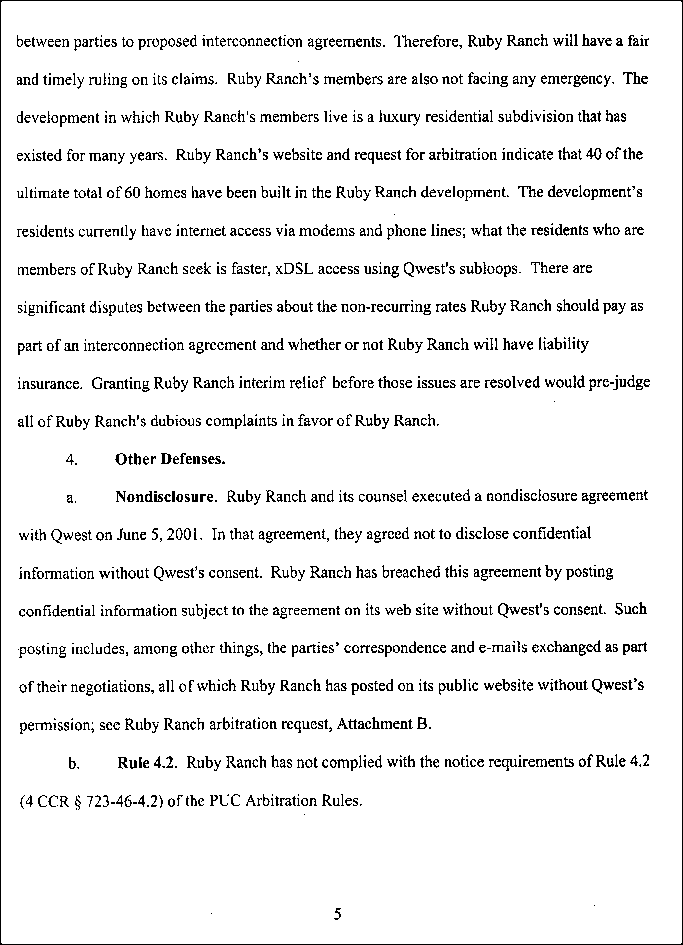
Qwest opposes the Coop’s request for interim relief because Ruby Ranch residents “live in a luxury residential subdivision” and have “internet access via modems and phone lines.”(21) Apparently, Qwest believes that it alone can determine who is deserving of high-speed, “always on” Internet access.
Qwest does not define what it means by “luxury,” but this omission is irrelevant because Congress did not hold that rights under the Communications Act apply only to persons owning “non-luxury” homes – however defined. The Coop is also perplexed by Qwest’s reliance on the fact that Ruby Ranch residents should be happy with the 26 kbps access they have with Qwest’s dial-up service,(22) given that Qwest has invested millions in order to provide its own DSL services. Qwest states of its DSL service:
Are you wasting time with the “world wide wait,” instead of flying from site to site across the World Wide Web? * * * Depending on the Qwest DSL service you select, you can enjoy speeds up to 25 times faster than the fastest analog modem and an “always on” connection. Step up to speed without breaking your budget.(23)
Residents of Ruby Ranch do not have the option to choose Qwest’s “always on”/high-speed Internet access service because Qwest has decided that we are not worthy of receiving its DSL services despite the fact that according to Qwest, we live in a luxury residential subdivision.(24) Indeed, we formed our Coop precisely because there is no meaningful option to most Ranch residents.
The Coop submitted its request for interim relief because Qwest stated that it “will do whatever we can . . to assist Ruby Ranch in meeting its needs,”(25) and because it hoped this relatively straightforward matter could be resolved before snow blanketed the ground. Regrettably (but not for the ski industry), snow now covers Summit County, and the Coop will need to wait until the spring before it buries the cable that it would interconnect with Qwest’s screw terminal and cross-connection box.
Nevertheless, Qwest has had numerous opportunities over the past six months to justify its non-recurring fees and insurance requirement. The Coop should not be subjected to the time demands of an arbitration hearing to litigate an issue that Qwest has chosen not to defend. The Coop therefore requests that the Commission enter a summary judgment in favor of the Coop on the three issues raised in its Arbitration Petition. Alternatively, the Coop requests that the Commission promptly enter an order requiring Qwest to enter into an interim agreement permitting the Coop to launch service. If we live in a luxury subdivision as Qwest asserts, Qwest need not be concerned about payment if the Commission were to later hold that Qwest's unsupported non-recurring fees and insurance requirements should be adopted.
IV. THE COOP’S RESPONSE TO QWEST’S “OTHER DEFENSES”
The Coop below responds to the three “other defenses” that Qwest raised in its Response.
A. Nondisclosure. Qwest complains that the Coop “breached” its non-disclosure agreement with Qwest by posting certain correspondence on the Coop’s web site.(26) It is understandable that Qwest did not explain the basis for its assertion. First, there is no Confidentiality Agreement that the Coop is aware of. While the Coop did execute on June 5, 2001 a modified version of the draft agreement that Qwest sent to it, Qwest has never sent the Coop a copy of that document that it executed – suggesting that it never executed the document.
Second, even if Qwest executed the Confidentiality Agreement, none of the correspondence that the parties exchanged (largely summarizing positions) contained “Confidential Information” as that term is defined in the Agreement.(27) Third, even if some of the correspondence did contain information that Qwest might consider to be confidential, the Agreement explicitly provides that information is deemed confidential only “so long as same is contemporaneously or subsequently provided in written form and marketed ‘Confidential Information,’”(28) yet Qwest did not mark any of its letters or emails as confidential. Finally, the Coop posted the parties’ correspondence only after it submitted its September 4, 2001 informal complaint letter to the Commission and the FCC. This posted material is certainly relevant to the informal complaint, as well as the Arbitration Petition. Is Qwest suggesting that the Coop could attach paper copies of these documents to these regulatory filings but not post the same documents on its web page to save a tree or two?
B. Rule 4.2. Qwest complaints that the Coop has “not complied” with the notice requirements of Rule 4.2.(29) The Coop agrees, and it was precisely for this reason that the Coop specifically requested a waiver of this rule (and other procedural rules that Qwest may recite) in its Arbitration Petition. On October 31, 2001, the Commission entered an order “granting Applicant’s request for waiver of Rule 723-46-4.2.”
C. Nonexistent Respondent. Qwest complains that the Coop erred in naming as the respondent Qwest Communications rather than Qwest Corporation. The Coop apologizes for this error. It named Qwest Communications because that is the name Qwest uses on its web site.(30) Qwest clearly is not prejudiced by this unintentional and harmless error in any way, and the Coop respectfully requests that the Commission substitute Qwest Corporation for Qwest Communications.
IV. CONCLUSION
The Coop seeks to provide “always on,” high-speed Internet access because Qwest has chosen not to serve Ruby Ranch, and Qwest has ample subloops available that the Coop could use in the provision of its DSL services. The unresolved issues are straightforward, and the Coop’s Arbitration Petition became necessary only because Qwest, despite clear FCC rulings to the contrary, decided not to provide cost support data for its non-recurring fees and refused to identify the risk the Coop might pose in order to justify an insurance policy of $1 million.
Notably absent in Qwest’s Response is any discussion of the public interest. Congress directed in Section 706(a) of the Telecommunications Act of 1996 that “each State commission with regulatory jurisdiction over telecommunication services shall encourage the deployment on a reasonable and timely basis of advanced telecommunications capability to all Americans.”(31) Residents of Ruby Ranch require the Commission’s assistance because Qwest has decided to act irrationally – depriving good customers (averaging three POTS lines per household) from the benefits of advanced telecommunications services when the only result would be that Qwest would generate new revenue for what would otherwise be a stranded investment. We would be appalled if we were Qwest investors, although Qwest’s position in this proceeding convinces us that investing in Qwest stock would not be a prudent investment.
The Coop requested subloops from Qwest on June 1, 2001, and the Commission is required to act on the Coop’s Arbitration Petition by March 1, 2002.(32) The Coop respectfully requests that the Commission decide the open issues promptly (if possible, before the end of the year), because the only beneficiary of a delay is Qwest.
Respectfully submitted,
______________________
Carl Oppedahl, Board Member
Ruby Ranch Internet Cooperative Ass’n
c/o Oppedahl & Larson LLP
P.O. Box 5088
Dillon, CO 80435-5088
970-468-6600
fax: 970-468-0104
carl@rric.net
Carl Oppedahl certifies that on November 27, 2001, he caused a copy of the foregoing Reply to be served via facsimile and first-class mail on the following persons:
Timothy M. Tymkovich
John R. Paddock, Jr.
Hale Hackstaff Tymkovich & ErkenBrack
1675 Broadway, Suite 2000
Denver, CO 80202
Kris A. Circcolo
Qwest Services Corporation
1005 17th Street, Suite 200
Denver CO 80202
______________________________
Carl Oppedahl
Footnotes
(1) From what the Coop can ascertain, a reply to a response to an arbitration petition is not addressed in the Commission's rules (i.e., a reply is neither permitted nor prohibited). If special permission is required, the Coop seeks leave to file this reply because it believes that the reply will narrow the controversy before the Commission and the Coop would like the opportunity to respond to the “other defenses” that Qwest raised for the first time in its Response.
(2) Qwest also made no attempt to challenge any of the five issues that the Coop raised in Section III of its Arbitration Petition. Given this silence, it is reasonable to conclude that Qwest agrees that the issues have been resolved in the manner that the Coop described.
(3) The Coop is confused by Qwest’s position. In its discussions with the Coop, Qwest has stated that the Coop must pay an activation fee of $126.49 for each subloop. However, according to its SGAT, the $126.49 charge applies only to the first subloop, with a $57.82 fee for additional subloops. See Qwest Colorado SGAT, Exhibit A at § 9.3.1 (Fifth Revision, Oct. 29, 2001). A reduced price for additional subloops makes sense, as Qwest obviously incurs less labor costs when it activates multiple subloops at one time.
(4) First Local Competition Order, 11 FCC Rcd 15499, 15578 ¶ 155 (1996).
(5) Id.
(6) Although Qwest has the burden to demonstrate that its proposed charges are cost-based, it remarkably asserts (not surprisingly without explanation) that there “is no factual or legal support for each of Ruby Ranch’s complaints.” Qwest Response at 2.
(7) 47 C.F.R. § 51.301(c)(8).
(8) Qwest Response at 2 and 3.
(9) Qwest Response at 2. Coop members do not have the resources to follow the Commission’s massive proceeding investigating Qwest’s SGAT prices. However, Qwest gives the impression that its SGAT prices have not been “approved” but are rather “pending.” Id.
(10) First Local Competition Order, 11 FCC Rcd at 15808 ¶ 610. Accordingly, the tariff laws that Qwest cites in its Response – Section 203 of the Communications Act and the filed rate doctrine – have no applicability to this arbitration proceeding.
(11) 47 U.S.C. § 252(f)(5).
(12) Qwest Colorado SGAT at § 1.5 (Fifth Revision, Oct. 29, 2001).
(13) See id. at § 5.6.1.4.
(14) The Coop does not ask that Qwest justify its prices to the penny, as evidenced by the Coop's willingness to pay $8.33 monthly for subloops as short as one-forth of a mile. However, the prices Qwest should charge should be reasonable, which its proposed non-recurring fees clearly are not.
(15) 47 U.S.C. § 252(b)(4)(B). See also 4 CCCR § 723-46-6.2.
(16) See Qwest Colorado SGAT. Exhibit A, at § 9.20.
(17) See Qwest Colorado SGAT, Exhibit A, at § 9.2.4.1.
(18) Because Qwest is the only carrier that provides telephone service to Ruby Ranch, both the Coop and its member-subscribers have every incentive to ensure that nothing they do interferes with their ability to obtain basic telephone service. It was precisely because of this concern that the Coop decided to provide SDSL (requiring separate loops) rather than ADSL (loops shared with voice service), even though shared loops are cheaper than separate loops.
(19) See Qwest Response at 4. It is noteworthy that Qwest initially took the position that it was “unable” to lower its initial demand for an $11 million policy.
(20) As a compromise, the Coop would propose to pay Qwest $10 monthly for each subloop (vs. $8.33), with the extra sums being dedicated to Qwest’s concern that there may be unspecified “accidents.”
(22) Given the poor quality of Qwest’s outside plant, 26 kbps is the maximum speed that Ruby Ranch residents than obtain with dial-up service, even if they have 56 kbps modems.
(23) See www.quest.com/jump/dsl. Qwest further notes, correctly, that it seems like DSL provides are failing left and right. See http://www.qwest.com/residential/products/dsl/index.html. The Coop further notes that notes that Qwest appears to have raised its prices once many of its larger competitors went bankrupt.
(25) Letter from Nancy J. Donahue, Qwest, to Carl Oppedahl, Coop (Oct. 12, 2001).
(27) Paragraph 2 of the Agreement provides: “As used herein, ‘Confidential Information’ shall mean any and all technical or business information, including third party information, furnished or disclosed in whatever tangible form or medium, orally, or by any other means by one Party to the other including, but not limited to, product/service specifications, prototypes, computer programs, models, drawings, marketing plans, financial data, and personnel statistics, so long as same is contemporaneously or subsequently provided in written form and marked ‘Confidential Information.’” This definition does not include a summary of the positions taken by the respective parties. Qwest cost data would fall within this definition, but Qwest never submitted any cost data to the Coop.
(28) Id.
(30) See www.qwest.com/index.html.
(31) See 47 U.S.C. § 157, note.
(32) See 47 U.S.C. § 252(b)(4)(C).